


Having the right gear isn’t just about comfort or performance — it’s a core part of staying safe while spearfishing. The following are essential items that every spearfisher should carry and maintain properly.
🥽 Mask
Your mask is one of the most important pieces of equipment. Without clear vision, your ability to hunt and stay safe is compromised.
- A poor-fitting or constantly fogged-up mask is frustrating and dangerous.
- Choose a mask that fits your face well — comfort and seal are critical.
- For deeper dives, a low-volume mask helps equalize more easily, but may reduce your field of vision.
- To prevent fogging, rub toothpaste on the inside of a new mask lens, rinse thoroughly before use.
🐬 Snorkel
Simple is best. All you need is a basic J-shaped snorkel.
- Avoid purge valves or splash guards — they add drag, dead space, and can fail unexpectedly.
- Choose a medium bore snorkel with a comfortable, soft mouthpiece.
- Hard or ill-fitting mouthpieces can cause gum pain, bleeding, or tongue swelling over time.
🧣 Wetsuits
A proper wetsuit keeps you warm, safe, and protected from the elements.
- Staying warm is critical — hypothermia is a real safety risk, even in moderate waters.
- Wetsuits are made from neoprene, which is buoyant. You’ll need a weight belt to balance this.
- Choose suit thickness based on water temperature:
- Lycra for warm tropical waters
- 3mm–5mm for temperate waters
- 7mm for cold waters
- Use a suit with a hood to prevent heat loss through the head.
- A proper fit is essential. Custom wetsuits are ideal for unusual body shapes.
- Open cell wetsuits are softer, warmer, and more flexible (but require soapy water to put on and have shorter lifespans).
- Look for a suit with a loading pad on the chest to protect against bruising from gun loading.
- Wetsuits also offer protection from sunburn and marine stingers.
🦶 Fins
Fins are your engine in the water — choose them wisely.
- Use long-bladed fins, which are ideal for spearfishing.
- Fit is critical:
- Too tight = foot cramps
- Too loose = blisters or lost fins
- Most spearo fins are closed-heel — wear with neoprene socks for comfort and fit.
- Open-heel fins are rare in spearfishing and often lack power.
- Regularly inspect your fins for cracks or fatigue, especially if using composite or carbon blades — a broken fin at sea can be a serious emergency.
⚖️ Weight Belt
A weight belt balances your buoyancy — it’s a critical piece of safety gear.
- Choose your weighting carefully — everyone’s needs vary based on body size, wetsuit thickness, and dive depth.
- For shallow diving: stay positively buoyant until 6m.
- For deeper diving: aim to be neutral at around 10m.
- This buoyancy ensures that in case of blackout, your suit will help float you back to the surface.
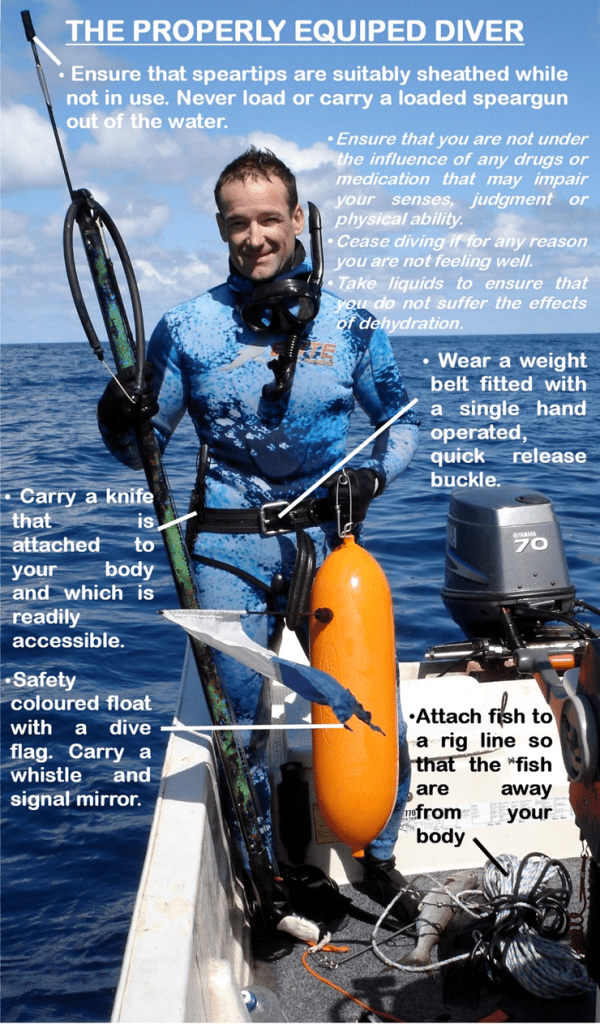
- If you feel faint or are involved in a rescue: immediately ditch your belt.
- Avoid over-weighting — it’s better to swim down against buoyancy than to struggle coming back up.
- A good rule: after exhaling at the surface, you should still float.
- Most spearos use a Marseilles rubber weight belt with a quick-release buckle — it compresses with your wetsuit and stays in place.
- For deep diving, open your buckle while ascending. If you black out, the belt can fall away and your buoyancy will carry you upward.
- Always carry a second backup weight belt — it makes the decision to ditch the first one easier in an emergency.
🔪 Knife
A dive knife isn’t for sharks — it’s for safety and humane dispatching of fish.
- Use it to:
- Dispatch fish quickly and safely
- Cut yourself free from tangled lines or ropes
- Choose a small, sharp, and strong knife.
- Bulky knives are dangerous — they snag easily and create unnecessary drag.
- Many prefer flat knives in pancake-style sheaths for a slim, streamlined fit.
🧤 Gloves & Socks
These add comfort and protection — don’t dive without them.
- Gloves protect from cold, coral, fish spines, and rough rocks.
- Neoprene socks are essential with closed-heel fins to prevent blisters and improve fit.
🧳 Dive Bag
Keep your gear organized and protected.
- A large mesh bag holds all your gear, including long fins.
- It keeps your equipment together, dries faster, and saves space on the boat or shore.
Having the right gear and maintaining it properly will make you a safer, more effective, and more comfortable diver. Check your equipment before every trip — your life may depend on it.
SPEARSAFE CONTENTS
 Australian Underwater Federation - Spearfishing